From Data Foundations to AI Readiness
As organizations race to operationalize AI, many are discovering a hard truth: AI outcomes are only as good as the data foundations beneath them. Without trusted history, clear context, and strong governance, even the most advanced AI models struggle to deliver reliable results.
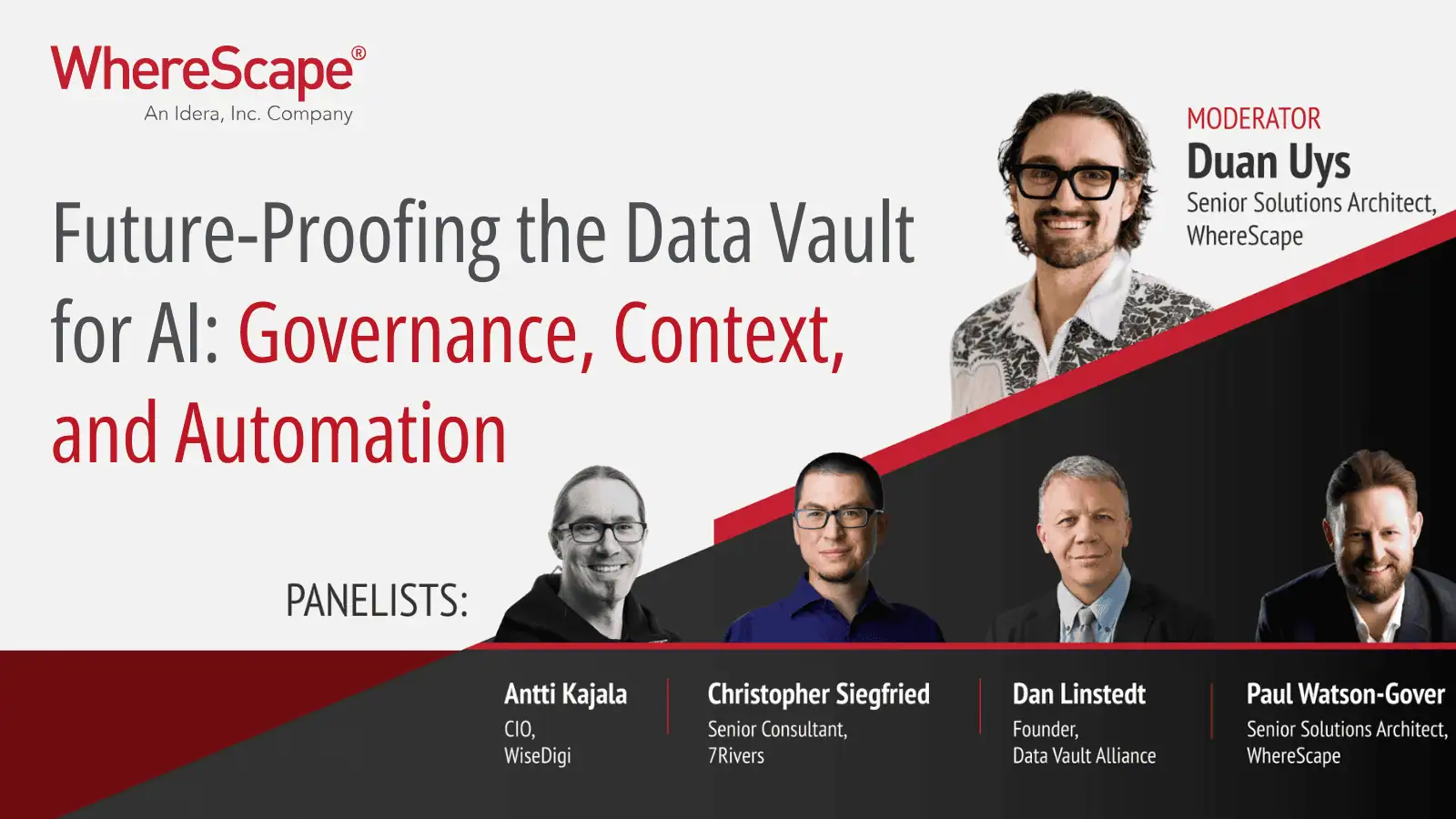
In this expert panel discussion, WhereScape brought together leaders from across the Data Vault community to explore how organizations can use a Data Vault for AI to prepare their data environments, apply automation responsibly, and deliver trusted outcomes at scale.
Moderator:
Duan Uys, Senior Solutions Architect, WhereScape
Panelists:
- Dan Linstedt, Inventor of Data Vault, Founder, Data Vault Alliance
- Paul Watson-Gover, Senior Solutions Architect, WhereScape
- Christopher Siegfried, Senior Consultant, 7Rivers
- Antti Kajala, Co-Founder & CIO, WiseDigi Oy
Together, the panel explored AI readiness, governance, automation, and the evolving role of Data Vault in modern analytics architectures.
Why It Matters: AI Demands Engineered Data Foundations
AI has accelerated the shift away from ad hoc data projects toward engineered data systems designed for trust, lineage, and repeatability. This is where Data Vault continues to play a critical role.
Dan emphasized that AI does not eliminate the need for disciplined data modeling — it makes it more important.
“AI is very good at spotting relationships, but without guidance, governance, and ontologies, it will guess the wrong relationships and reinforces them. Generally speaking, the more specific the question, the better the outcome.”
— Dan Linstedt
Rather than replacing data architecture, AI amplifies both its strengths and weaknesses. Organizations with strong foundations move faster. Those without them scale problems more quickly.
Context Is King: Why Metadata Matters More Than Ever
Throughout the discussion, one theme surfaced repeatedly: context. For AI models to deliver meaningful insights, they must understand not just the data but the business meaning behind it.
Christopher explained how metadata is no longer optional or secondary.
“In addition to the normal data you would see surfaced, we’re seeing much more metadata being surfaced in Data Vaults and warehouses. Metadata is moving from being an afterthought to becoming part of the business process itself.”
— Christopher Siegfried
Duan framed the discussion by grounding it in practical terms:
“We keep saying that context is king, but the real question is what that actually means in practice when you are using AI against enterprise data.”
— Duan Uys
Paul connected context directly to AI reliability:
“You have to provide clear context to an AI in order to get a decent response. It’s a continuation of the same principle we’ve always had: garbage in, garbage out.”
— Paul Watson-Gover
Together, the panel reinforced that AI success depends on semantically organized data, governed metadata, and business-aligned context, all core strengths of Data Vault.
Automation and AI: Where the Line Should Be Drawn
As AI adoption grows, so does the temptation to automate every stage of the data lifecycle, including decisions that require business understanding and architectural judgment. The panel agreed that while automation is essential for scale and consistency, it should accelerate execution, not replace thinking.
Antti emphasized that the biggest risk is not automation itself, but how responsibility shifts when AI is introduced without clear guardrails.
“It really comes back to the human factor. From a corporate management perspective, you have to be willing to trust and value your business users, the people who truly understand the business and the data. You have got to be careful with the questions you are asking and the data sets you are using.”
— Antti Kajala
Automation delivers the most value when applied to repeatable, pattern-based work such as code generation, documentation, testing, and enforcement of standards. These are areas where speed, consistency, and scale matter most.
However, the conceptual modeling decisions that define business meaning still require human expertise. AI can assist and validate, but without strong business input and governance, automation risks producing outputs that are technically correct yet misaligned with real-world intent.
Myths About “AI-Ready” Data Architectures
Several common misconceptions surfaced during the discussion, particularly as organizations rush to position their platforms as “AI-ready.”
One of the most persistent myths is that AI will fix bad data. While AI can help identify anomalies and patterns, it cannot correct poor data quality on its own. If the underlying data lacks consistency, context, or business meaning, AI will simply accelerate those issues rather than resolve them.
Another misconception is that entirely new architectures are required for AI. In reality, AI does not replace the need for disciplined data modeling. Organizations do not need to abandon their data warehouses or start from scratch. What they need is a strong, well-structured foundation that supports traceability, history, and governance.
There is also a belief that AI governance slows innovation. The panel strongly disagreed. Governance does not limit AI. It enables it. Without clear rules, definitions, and accountability, AI systems can reinforce errors, amplify bias, and produce misleading results at scale.
“AI is an accelerator, not a solution. Without governance and clear context, it will reinforce bad data, guess the wrong relationships, and scale those mistakes faster.”
— Dan Linstedt
Dan emphasized that AI should be treated as an accelerator rather than a solution in itself. When paired with governed data models and clear business context, AI can deliver meaningful insights faster and more reliably.
Data Vault’s structured approach provides the discipline AI needs to be effective by preserving history, enforcing consistency, and embedding governance directly into the architecture.
Where Automation Adds Real Value
When used correctly, automation and AI work best together. Automation enforces standards, consistency, and repeatability across the data lifecycle, while AI enhances discovery, pattern recognition, and validation when it is properly trained and governed.
Paul noted that automation lays the groundwork for AI success by creating reliable, repeatable data structures enriched with metadata and lineage. These foundations allow AI systems to operate within clear boundaries rather than interpreting data in isolation.
Christopher expanded on this idea by explaining how automation elevates metadata from a technical artifact to a core business asset.
“Metadata is no longer something that just supports the warehouse. It becomes part of the business process itself, giving AI the semantic structure it needs to understand how data should be used.”
— Christopher Siegfried
Rather than replacing data engineers and architects, automation allows them to focus on higher-value work. By removing repetitive manual tasks, teams can spend more time refining business logic, validating outcomes, and aligning data products with real-world decision-making.
Antti reinforced that automation is most effective when it supports people who understand the business, not when it attempts to replace them.
“Automation works best when it supports the people who truly know the business and the data, instead of forcing teams to spend their time validating automated output.”
— Antti Kajala
When automation is applied to the right problems, it strengthens trust and transparency across the data pipeline. When combined with human expertise and governance, it becomes a force multiplier rather than a risk.
Final Takeaway: AI Is an Assistant, Not a Replacement
This discussion made one point clear: AI does not eliminate the need for strong data foundations, it depends on them.
Data Vault remains a powerful methodology for supporting AI because it provides history, traceability, and governance by design. Automation accelerates implementation. AI enhances insight when guided by human expertise.
As organizations move forward, success will come not from chasing AI trends, but from building trustworthy, context-rich data systems that scale responsibly.
Ready to See It in Action?
If you’re exploring how to prepare your Data Vault architecture for AI, without sacrificing governance or control, WhereScape can help.
👉 Watch the full webinar on demand
Request a personalized demo to see how metadata-driven automation supports AI-ready data platforms
Webinar Q&A Highlights
Q: Can AI fully design and maintain a Data Vault-based data warehouse on its own?
A: The panel agreed that while AI can assist with automation, it cannot replace architectural decision-making. Christopher Siegfried noted that AI works best when standards, verification rules, and governance are clearly defined in advance. Without those guardrails, AI output requires excessive human validation, reducing its value.
Q: Does AI reduce the need for data governance?
A: No. In fact, governance becomes more critical as AI adoption increases. Dan emphasized that AI will reinforce whatever patterns exist in the data, including bad ones. Without governance, AI can amplify errors rather than correct them.
“Without guidance, governance, and ontologies, AI will guess the wrong relationships and reinforce them.”
— Dan Linstedt
Q: Can AI help clean or fix poor-quality data?
A: AI can help identify anomalies and patterns, but it cannot fix bad data on its own. The panel stressed that human expertise is required to understand business meaning, validate results, and determine corrective actions. AI should be treated as an assistant, not an authority.
Q: How important is metadata when using AI with Data Vault?
A: Metadata is essential. Christopher explained that metadata provides the semantic layer AI needs to understand business processes. Without it, AI lacks the context required to deliver reliable outcomes.
Q: Where does automation add the most value in an AI-enabled Data Vault environment?
A: Automation delivers the greatest value in repeatable, pattern-based work — such as code generation, documentation, testing, and enforcement of standards. Antti cautioned that automation should accelerate delivery, not shift teams into full-time validation roles.
Q: Is it realistic for AI agents to fully own data warehouse design in the future?
A: The panel viewed this as theoretically possible but premature. Paul raised concerns about long-term validation and knowledge retention if organizations rely entirely on AI-driven design without maintaining internal expertise.
Q: What’s the biggest misconception about becoming “AI-ready”?
A: That AI can compensate for weak data foundations. The panel agreed that AI readiness starts with disciplined modeling, governance, and business alignment — not new tools or architectures.
About the Panelists
Duan Uys is a Senior Solutions Architect at WhereScape, where he works closely with customers to design and modernize scalable data warehouse and analytics architectures. With deep experience in metadata-driven automation and Data Vault implementations, Duan regularly advises organizations on building trusted, future-ready data platforms.
Dan Linstedt is the Founder of the Data Vault Alliance and the inventor of the Data Vault system of information management. With decades of experience in data architecture, data governance, and large-scale enterprise systems, Dan is widely recognized as a leading authority on designing resilient, auditable, and AI-ready data platforms.
Paul Watson-Gover is a Senior Solutions Architect at WhereScape with over 20 years of experience in data warehouse automation. Paul specializes in helping organizations apply automation, governance, and best practices across complex data environments while maintaining flexibility as architectures evolve.
Christopher Siegfried is a Senior Consultant at 7Rivers, where he works with organizations to modernize data platforms and enable advanced analytics and AI use cases. His work focuses on semantic modeling, metadata-driven design, and aligning data architectures with real-world business processes.
Antti Kajala is the Co-Founder and CIO of WiseDigi Oy, where he leads data engineering, data modeling, and analytics initiatives. With hands-on experience across Data Vault implementations and modern data platforms, Antti brings a pragmatic perspective on balancing automation, governance, and business value.
About the Authors
Duan Uys is a Senior Solutions Architect at WhereScape and served as the moderator for this discussion. He works directly with customers to translate complex data architecture concepts into practical, scalable solutions, with a focus on metadata-driven automation, governance, and modern analytics platforms.