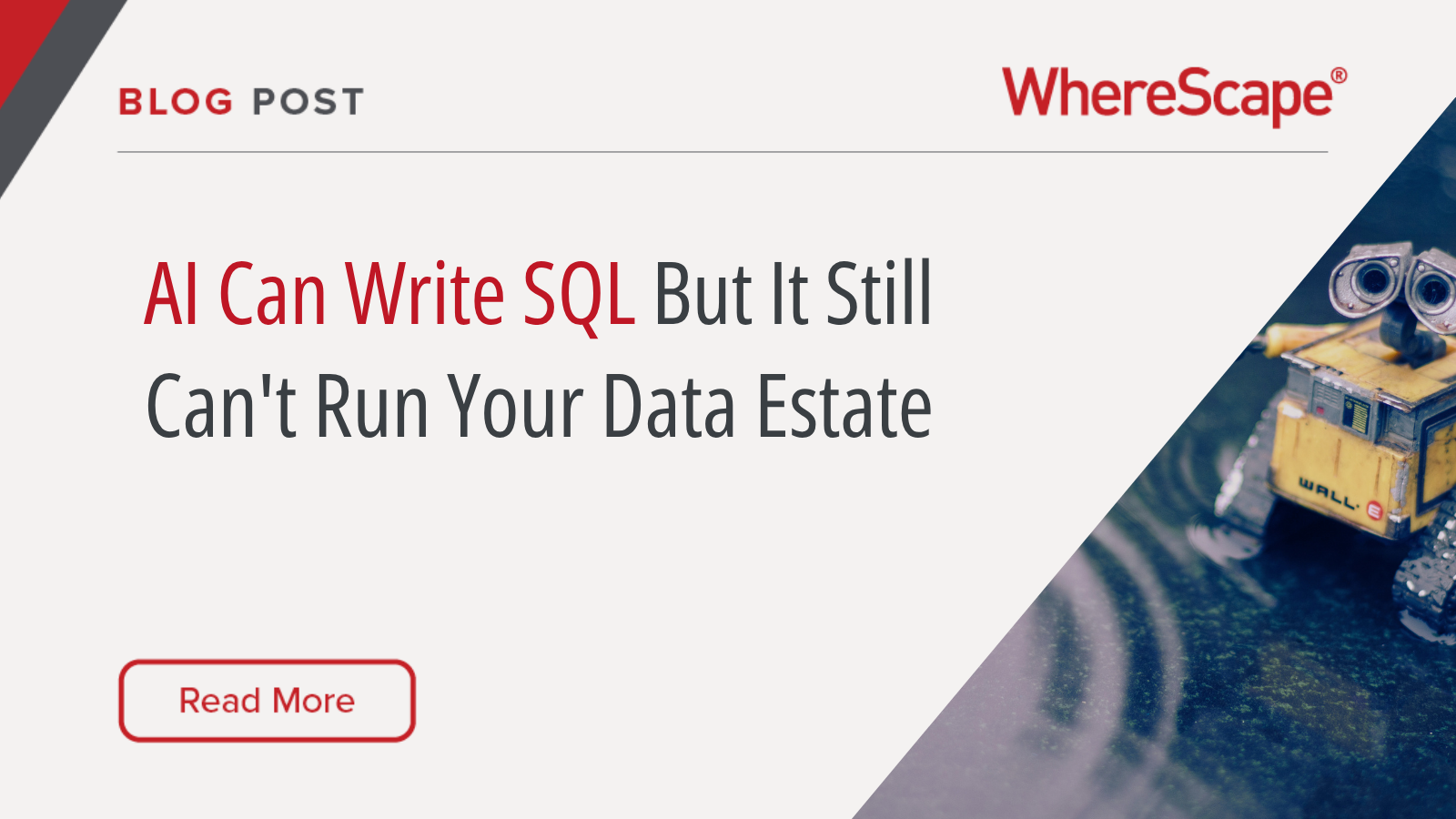
AI can generate SQL remarkably well. Give a modern AI model a schema, explain the desired output and within a few seconds it can produce joins, transformations, window functions, stored procedures and increasingly sophisticated data pipelines. For data engineers who have spent years writing and debugging these types of things manually, that can feel like a pretty big shift in how the work gets done.
It is also easy to overestimate what this capability actually means. Writing SQL is only one part of running a modern data estate, because enterprise data environments also depend on architecture, metadata, dependencies, business rules, security policies, naming standards, deployment processes, lineage and operational knowledge. An AI model can generate technically valid SQL while understanding very little about any of those surrounding requirements.
As AI becomes more capable, the more useful question for data teams is therefore changing. Instead of asking whether AI can generate the code, we increasingly need to ask whether it understands enough of the surrounding data environment to generate the right code, make changes safely and operate within the standards of a production system. That distinction may become one of the defining issues in the next phase of AI-driven data engineering.
AI Has Made Code Generation Cheap
SQL is unusually well suited to generative AI. It is structured, extensively documented and represented across enormous quantities of training data, while its intent can often be expressed clearly in natural language: join these tables, aggregate revenue by region, identify duplicate records, generate a Slowly Changing Dimension or calculate a rolling average.
AI coding assistants can already perform many of these tasks competently. Data engineers increasingly use them for SQL generation, debugging, documentation, query explanation, transformation logic and initial pipeline development, and there is little reason to expect that trend to slow down. The economic consequence is important: producing plausible code is becoming faster and cheaper.
But enterprise data engineering was never difficult simply because engineers had to remember SQL syntax. The difficult part was understanding how an individual piece of code fits into a much larger system and that challenge remains, even when the code itself can be generated in seconds.
Consider a seemingly straightforward request to add customer lifetime value to an analytics warehouse. The calculation might be easy to express in SQL but before implementing it somebody still needs to understand which customer identifier is authoritative, which source systems contribute transactions, how refunds and cancellations should be handled, whether currencies need to be normalized, how often the value should refresh and what downstream assets already depend on the customer model.
There are implementation questions too. The team may need to determine how historical values behave when business logic changes, which naming and modeling standards apply, how the change moves from development into test and production, what validation should occur before release and how the new logic will be documented for future engineers. None of these are primarily SQL problems, they are instead context problems … and context is becoming one of the most valuable assets in an AI-enabled data estate.
Why AI Needs More Than a Database Connection
Large language models are probabilistic systems. They generate outputs based on patterns, instructions and whatever context is available at the moment of inference. Enterprise data platforms operate under a different set of expectations because production environments need repeatability, control and predictable outcomes.
A data load either completes correctly or it does not. A deployment has a defined version, a transformation should follow an agreed rule, access should respect permissions and dependencies should execute in the correct order. Giving an AI agent access to a database therefore solves only a small part of the wider engineering problem.
The agent may be able to inspect tables and generate SQL but database schemas rarely contain the complete meaning of an enterprise data environment. Important knowledge is often distributed across transformation code, orchestration tools, modeling software, Git repositories, documentation, naming conventions, support tickets and, sometimes, the memories of the people who have maintained the environment for years!
A database can tell an AI system a great deal about what exists. Metadata can help explain what those objects mean, where they came from, how they are connected and what rules should apply when they change.
This is one reason metadata-driven data automation becomes more relevant as AI adoption increases. In a metadata-driven environment, more of the knowledge about a data platform is captured explicitly rather than being buried solely inside hand-written SQL or retained as tribal knowledge.
Generating SQL Is Not the Same as Engineering Data
Imagine asking an AI model to create a new dimension table. With sufficient schema information, it could generate a plausible CREATE TABLE statement and the transformations required to populate it, and in a simple environment that may be enough to produce something useful.
An experienced data engineer, however, is usually considering a much wider system. They may need to think about source profiling, surrogate keys, Slowly Changing Dimension behavior, naming conventions, data types, indexes, incremental processing, orchestration dependencies, error handling, auditing, documentation, lineage, deployment environments and downstream consumers before the object ever reaches production.
That wider system is what makes data engineering different from code generation. AI can participate in it, and over time it will probably participate far more extensively, but doing so reliably requires access to the context and guardrails that experienced engineering teams already use to control their environments.
A useful way to think about this relationship is that AI provides reasoning, metadata provides context and automation provides repeatability. These are related capabilities but they solve different problems. The more interesting opportunity begins when all three operate together harmoniously.
Metadata Could Become a Control Plane for AI
Metadata has traditionally been described as information about data: table names, column definitions, mappings, lineage, documentation and relationships between objects. In an AI-driven environment, however, its role can become much broader because metadata can also describe the architecture in which an AI agent is being asked to operate.
For example, metadata might establish that a particular source column maps to a specific warehouse attribute, that personally identifiable information requires masking, that customer dimensions follow an approved modeling pattern or that one transformation must execute before another. It might also describe ownership, deployment rules, naming conventions, data quality expectations and lineage across multiple layers of the platform.
This makes metadata valuable not just to engineers and architects but to automation systems and AI agents. A sufficiently rich metadata layer can help answer questions such as what an object represents, where its data originated, which transformations produced it, which standards apply to it, what depends on it, who owns it and very importantly … what might break if it changes.
These are exactly the kinds of questions an AI system needs to answer before it can participate safely in enterprise data engineering. This is also why we see data governance and lineage as part of the engineering lifecycle rather than an exercise completed after development. When documentation, lineage and impact information are generated from the same metadata used during design and development, they remain much closer to what is actually deployed.
AI Agents Raise the Stakes
The rise of AI agents makes this problem even more important because an agent can potentially do more than answer a question. It can interact with systems, call tools, retrieve information and (depending on how it is configured) take actions within an operational environment.
Standards such as Model Context Protocol, aka MCP, are accelerating this shift by giving AI systems a more standardized way to discover and interact with external tools and data sources. Microsoft, for example, now provides SQL MCP Server capabilities designed to let AI agents interact with SQL databases through controlled operations, while Microsoft Fabric also supports data agent scenarios that can expose enterprise data to AI-driven workflows.
This changes the risk profile. If an AI assistant only suggests SQL, a human can review the recommendation before anything happens. If an AI agent can inspect schemas, execute tools, modify assets or initiate workflows, then the quality of the context, permissions and controls surrounding that agent becomes much more important.
The agent needs to know what it can do, but a well-governed system also needs to help it understand what it should do. The second problem is considerably harder, because it depends on business context, architecture and operating rules that may not exist in any single database.
Probabilistic AI Needs Deterministic Guardrails
There is a natural temptation to imagine increasingly capable AI agents replacing more and more of the traditional data engineering toolchain. Some of that will probably happen, particularly in areas where teams currently spend time translating relatively standard requirements into repetitive code.
At the same time, greater AI autonomy may increase the value of deterministic automation. An AI system might be perfectly suited to interpreting a request such as “add this source to our customer model using our standard ingestion pattern,” because it can inspect the source, reason about likely relationships and identify where human clarification may be needed.
Once the desired change has been established, however, an organization may prefer a predictable automation framework to carry out the implementation. That framework can apply approved templates, naming conventions, deployment rules, audit requirements and architectural patterns consistently rather than asking the AI to improvise every production artifact from scratch.
This creates a useful division of labor. AI can remain flexible where interpretation and reasoning are valuable, while automation can remain deterministic where repeatability and governance matter. In practice, this could prove more scalable than expecting an AI model to independently recreate years of engineering standards every time it generates code.
What Does an AI-Ready Data Estate Actually Need?
AI readiness is often discussed almost entirely in terms of data quality and trusted data is certainly an important part of the picture. We have written about creating an AI-ready data environment using validation, governance, profiling and metadata visibility … but true AI readiness for data engineering should go even further.
A genuinely AI-ready data estate should make its structure and operating rules understandable to machines as well as people. That means developing several capabilities that already provide value today and are likely to become even more important as agents become more capable:
- Machine-readable metadata. Sources, mappings, models, transformations, dependencies and business rules become more useful when they can be interrogated programmatically.
- Reliable lineage. AI needs to understand relationships between assets before making changes, particularly when a modification could affect downstream models, reports or applications.
- Standardized engineering patterns. Naming conventions, loading patterns, modeling rules, security requirements and deployment processes reduce ambiguity and give AI clearer boundaries within which to work.
- Automated documentation. Documentation generated from the same metadata used to build the environment is less likely to drift away from production reality.
- Controlled deployment. Code generation and code deployment should remain separate concerns, with version control, testing, approvals and rollback mechanisms protecting production environments.
- Impact analysis. Before changing an object, an AI-enabled workflow should ideally understand what depends on it and which downstream assets may be affected.
None of these capabilities exist solely for AI. They make data environments easier for people to manage as well, which is one of the strongest arguments for investing in them now rather than waiting for some future level of agent autonomy.
Hold On, Could AI Eventually Run the Whole Data Estate?
Perhaps. Perhaps not. AI is developing quickly enough that categorical predictions about what it will never be able to do are unlikely to age particularly well and it would be difficult to rule out increasingly autonomous engineering systems over the next several years.
The more useful question is perhaps more along the lines of: what infrastructure such a system would require to operate reliably? Even a very capable AI agent would benefit from accurate metadata, clear architectural rules, trusted lineage, version history, controlled access, standardized deployment mechanisms and well-defined boundaries around what it is permitted to change.
Experienced human engineers benefit from exactly the same things, which means organizations do not need to predict the eventual endpoint of AI adoption before improving their foundations. Better metadata, automation, governance and standardization already make data teams more productive today, while also creating the context layer that future AI systems are likely to need.
From AI-Assisted Engineering to Agentic Data Operations
Today, AI frequently sits beside the engineer. It explains existing code, generates SQL, suggests transformations, produces documentation and helps troubleshoot errors (though usually with a human retaining responsibility for the broader engineering process).
The next stage is likely to involve much deeper interaction with engineering systems themselves. Agents may inspect metadata, compare models, investigate failed jobs, identify dependencies and initiate approved workflows, while engineers increasingly work at the level of requirements, architecture and exceptions rather than individual statements of code.
Eventually, a data engineer may be able to express a much higher-level intent such as: “We have acquired a new business. Integrate its customer and transaction systems into our existing analytics architecture.”
An AI agent could inspect the incoming systems, profile the available data, identify likely relationships and propose mappings. A metadata-driven design environment could represent the proposed architecture, while automation could generate standardized pipelines and models. Impact analysis could identify affected assets and CI/CD processes could test and promote approved changes through controlled environments.
In that scenario, humans may spend less time creating individual transformations and more time defining architecture, business rules, standards and acceptable outcomes. That feels like a more meaningful evolution of data engineering than simply asking AI to write progressively longer SQL queries.
Where Data Automation Fits Into the Bigger Picture
At WhereScape, we have spent literally decades approaching data engineering through metadata and automation. Our products capture information about sources, models, transformations and dependencies, then use that metadata to help generate, orchestrate, document and maintain the data environment.
Our visual data modeling tool WhereScape 3D for example, supports source discovery, metadata capture, data modeling, standards and impact analysis. Those designs can feed repeatable development processes rather than leaving every engineer to manually translate an architecture into implementation.
AI adds another possible intelligence layer to that lifecycle. It can help engineers interact with metadata, interpret requirements, understand unfamiliar systems and accelerate design decisions, while automation provides the controlled mechanism for turning those decisions into production data infrastructure.
The opportunity, in our humble view, is therefore a bigger deal than just faster SQL generation. As AI becomes better at reasoning about data systems, its usefulness will increasingly depend on the quality of the metadata, standards and automation it can work with.
How Data Teams Can Prepare, Starting Now
Organizations do not need autonomous data engineering agents before preparing their environments for them. In many cases, the same steps that make a data estate easier for AI to understand also make it easier for engineers to manage today.
Teams can start by capturing architectural metadata rather than relying exclusively on code, standardizing common modeling and transformation patterns, generating documentation and lineage during development and identifying dependencies before changing production assets. They can also keep a clear separation between AI-generated suggestions and controlled execution, maintain versioning and testing processes and reduce undocumented tribal knowledge around critical pipelines.
Perhaps most importantly, governance should be treated as part of engineering rather than something added after the fact. When rules, dependencies and ownership are visible during development, they become useful inputs into both human decision-making and future AI-assisted workflows.
AI Is Changing What We Should Automate
For years, one of the main arguments for data automation was straightforward: engineers should not repeatedly write boilerplate SQL when software can generate it faster and more consistently. Generative AI strengthens that argument while also changing its shape.
Producing code may soon become one of the least scarce parts of data engineering. Understanding the estate becomes relatively more valuable, as does knowing which standards apply, how objects relate, what a change will affect, how an implementation should be deployed and whether the result can be trusted.
The organizations best positioned for AI may therefore be those whose data environments are already explicit, structured and understandable. AI can generate SQL but running a data estate requires context, and much of that context lives in metadata, governance, architecture and automation.
As AI agents become increasingly capable of acting rather than merely answering, those foundations are unlikely to become less important. Instead, they may become the very things that determine how far organizations can safely allow AI to go.
Frequently Asked Questions – AI & SQL
Yes. Modern generative AI systems can produce SQL queries, transformations and database code from natural-language instructions, and their capabilities continue to improve. Their effectiveness still depends heavily on the quality of the schema information, business context and instructions provided to them.
AI is more likely to change the work data engineers perform than eliminate the need for data engineering altogether. As code generation becomes easier, architecture, governance, modeling, data quality, business context and operational control become relatively more important.
Metadata-driven automation uses structured information about sources, models, mappings, transformations and engineering rules to generate and manage data infrastructure. Instead of manually implementing each object independently, teams define patterns and metadata that automation can apply consistently.
Metadata provides context about the data environment. It can describe what data means, where it originated, how assets relate, which standards apply and what dependencies may be affected by a proposed change.
Model Context Protocol provides a standardized way for AI applications and agents to discover and interact with external tools and data sources. In data engineering, MCP can help agents interact with databases, platforms and engineering systems through defined interfaces rather than relying only on conversational prompts.
A useful starting point is trusted data, machine-readable metadata, reliable lineage, standardized engineering patterns, automated documentation, controlled deployment processes and strong governance. These capabilities help people manage complex data environments today while providing richer context for AI-assisted and agentic workflows in the future.