WhereScape RED has been helping data teams automate warehouse development for more than two decades. We launched RED in 2003, three years after WhereScape was founded in Auckland way back in the year 2000, with a goal that still feels familiar today: remove repetitive manual work from data engineering and help teams deliver useful data faster.
It’s safe to say that a lot has changed since then. Many data warehouses have been moved from dedicated on-premises databases to cloud platforms and lakehouses. DevOps has become part of everyday data delivery. Metadata, lineage and governance have grown in importance and in the last few years, AI is creating another wave of change in how organizations expect to interact with their data.
RED has changed alongside that ever-changing landscape. RED 10, launched in 2023, introduced a new generation of the platform and development has continued through subsequent releases. Our latest RED 10.7 release, for example, adds new validation checks, richer 3D exports and additional headless automation capabilities.
But now, we’re hard at work; determined to conquer another major milestone.
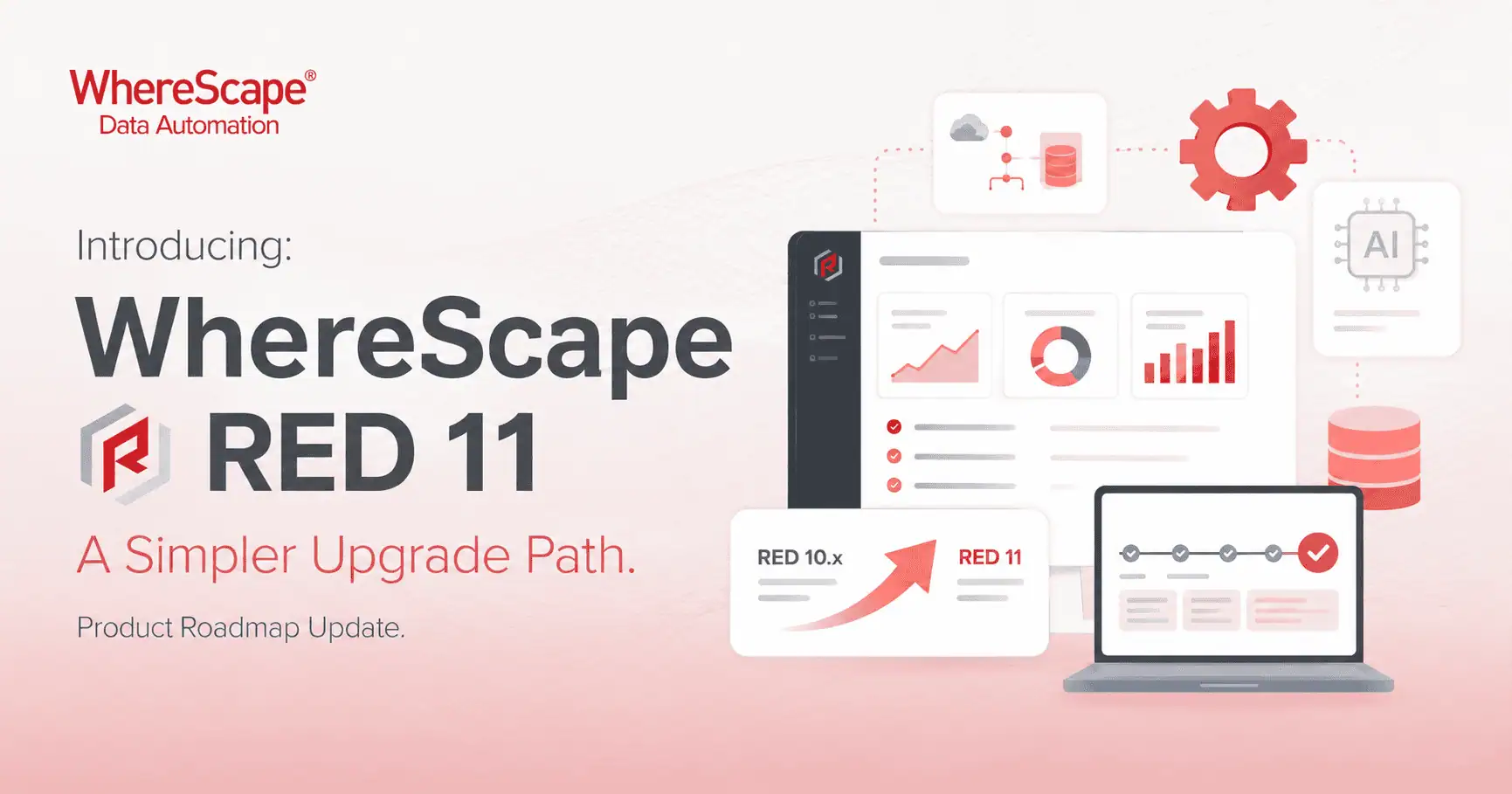
WhereScape RED 11 is officially in development.
The Main Goal for RED 11: Make Moving Forward Easier
One theme has come through particularly clearly in conversations with our customers and partners.
For some long-standing RED users, moving from an older version of RED to RED 10 felt less like a conventional software upgrade and more like a full-on migration project.
We listened to and fully digested that feedback, which is why RED 11 is being designed with a much simpler principle in mind:
Customers should be able to move forward, without having to start again.
Our development goal is to combine the newer capabilities introduced through RED 10 with the continuity that customers running older RED environments need.
Our overarching intention is to create a straightforward upgrade path, rather than requiring our customers to embark on a migration-style project.
What this means is that we’re protecting the substantial investment many organizations have already made in RED.
Preserve What Works, Modernize What You Need
Data platforms tend to live for a long time.
We know RED customers that have spent years building jobs, templates, customizations, business rules and operational processes around their data warehouse. Those environments often contain considerable institutional knowledge and proven logic.
Modernization should not automatically mean throwing that work away.
As we develop RED 11, several principles are guiding the work:
- Simpler Upgrades. Our goal is to provide an easier path from RED 10 and older RED environments, using SQL repositories.
- Continuity for Existing Environments. Existing jobs, workflows and customizations are intended to move forward, rather than requiring customers to rebuild established systems.
- Incremental Modernization. Customers should be able to adopt newer capabilities when they make sense, rather than redesigning everything at once.
- Greater Stability. Investment continues across current RED releases, Enablement Packs and the RED 11 development program.
- A Refreshed Experience. A modernized user interface forms part of the longer-term RED 11 roadmap.
That point about incremental modernization is important to us and is something we’ve discovered is firmly rooted in reality. An organization may have a warehouse that is operating reliably today while also wanting newer automation, AI or platform capabilities for tomorrow. Those objectives do not need to conflict: RED 11 is being developed to make it easier to preserve stable parts of an environment, while gradually introducing newer functionality around them.
RED Development Is Already Moving in This Direction
RED 11 is part of our wider development effort, rather than an isolated future project.
Our recent RED releases have already focused heavily on reducing friction around installation, upgrades and everyday operation.
RED 10.5 introduced streamlined installation and scheduler upgrade workflows, including greater automation of steps that previously required manual configuration. While RED 10.7 continued that direction with eight validation checks designed to identify common scheduler installation and upgrade issues earlier.
These may look like separate improvements but they reflect a common objective: reduce the amount of manual work surrounding data delivery so teams can spend more time on architecture, business logic and the data itself.
RED 11 takes that philosophy into the next major generation of the product.
AI Is Part of the Roadmap Too
An easier upgrade path is the central story behind RED 11, although it is not the only area where we are investing.
We are also developing practical AI capabilities across the WhereScape portfolio.
The distinction we care about is practical.
There is no shortage of AI demonstrations that can generate SQL or answer a question about a database. Enterprise data engineering introduces harder requirements. AI-assisted workflows need context about metadata, lineage, templates, dependencies and established development patterns, particularly when they can influence production data systems.
Our direction is therefore centered on AI that works with governed WhereScape metadata rather than operating independently of it.
Areas we are actively developing and evaluating include:
- AI-Assisted Development. Using metadata, templates, lineage and established WhereScape patterns to help developers accelerate repeatable work.
- Natural-Language Access to Metadata. Allowing approved AI assistants to explore and understand WhereScape environments more conversationally.
- Model Context Protocol Integration. Developing MCP capabilities for WhereScape, so compatible AI tools can interact with repository metadata and selected workflows.
- AI-Assisted Data Modeling. Continuing development around AI capabilities for WhereScape 3D.
- Human Oversight and Governance. Keeping AI activity inspectable and controlled rather than treating autonomy as an objective by itself.
These capabilities are developing alongside the core RED roadmap. We expect AI to become another useful interface into metadata-driven automation; rather than a replacement for the architecture, governance and engineering practices underneath it.
Why Upgrade Compatibility Matters More in the AI Era
There is also a broader reason we are putting so much emphasis on continuity.
The current pace of technology change makes large replatforming projects increasingly difficult to justify.
An organization may want to adopt Microsoft Fabric this year, introduce new AI capabilities next year and modernize another part of its warehouse after that. If each improvement requires rebuilding the underlying data environment, modernization becomes expensive and disruptive very quickly.
Metadata-driven automation has always been intended to reduce that problem.
The RED product page today still reflects the core proposition that has guided our product design for so many years: automate ELT, orchestration and documentation – rather than hand-writing thousands of lines of data infrastructure code.
With RED 11, we want the product lifecycle itself to follow a similar philosophy: updating your automation platform should not undermine the automation benefits that made you choose it in the first place.
Listening to the People Who Actually Use RED
Perhaps the most important part of the RED 11 story is how we arrived here.
The simpler upgrade path is not something we invented in isolation. It comes directly from conversations with customers and partners who told us where the existing experience created unnecessary friction.
RED has been in the market since 2003. That longevity gives us customers with mature and sometimes highly-customized environments. It also creates a responsibility to think carefully about how innovation affects the people already using the product.
New functionality matters but compatibility matters too.
Modern interfaces matter but preserving proven workloads matters too.
AI matters, but so does stability, maintainability and predictable upgrades.
RED 11 is being developed as a way to strike a balance between the latest and greatest, while offering a solution that turly works as well in the real-world as it does ‘on paper’.
More to Come
We are announcing RED 11 while development is still underway because we want customers, partners and the wider data community to understand where we are investing.
There is deliberately plenty we are not announcing yet.
Final functionality, technical details and timing will become clearer as development progresses and we will share more when those plans are ready. As with any forward-looking roadmap, individual capabilities and timelines may evolve as we test, learn and incorporate further feedback.
What we can say clearly today is that WhereScape RED 11 is in development and simplifying the path forward for existing RED customers is at the heart of it.
RED began more than two decades ago, with the idea that it’s possible to take unnecessary manual work out of data warehousing. The technologies surrounding it have changed enormously since 2003 but that principle has aged surprisingly well.
With RED 11, we are applying it to the upgrade experience itself.
FAQ: WhereScape RED 11
Yes. WhereScape has begun development of RED 11 and is now sharing that direction publicly after discussing the roadmap with selected customers and partners.
A major focus is creating a simpler upgrade path for existing RED customers, particularly organizations using RED 9 or other RED versions with SQL metadata repositories.
Our development objective is to preserve existing jobs, workflows and customizations so that customers can move forward without treating the upgrade as a complete rebuild. Final technical requirements will be confirmed as RED 11 development progresses.
AI is an important part of the broader WhereScape roadmap. We are developing and evaluating capabilities including AI-assisted workflows, MCP integration for RED and AI-assisted modeling in WhereScape 3D. Specific RED 11 functionality and final scope will be confirmed closer to full release.
We are not announcing a release date at this stage. RED 11 is actively in development and we will share further information about timing and functionality as the roadmap progresses.