The Data + AI Summit 2024, hosted by Databricks at the bustling Moscone Center in San Francisco, has concluded with remarkable revelations and forward-looking innovations. Drawing over 16,000 attendees in person and virtually connecting over 60,000 participants from 140 countries, this event has solidified its place as a cornerstone in the data and AI landscape.
Here’s a high-level recap of the summit’s most significant announcements and insights.
Keynote Highlights

- Open-Sourcing Unity Catalog: One of the summit’s most groundbreaking announcements was the open-sourcing of Unity Catalog. This strategic move by Databricks aims to democratize data governance, providing a unified standard for managing both structured and unstructured data. With Unity Catalog now open source, organizations can achieve greater transparency and control over their data.
- Integration of Iceberg and Delta Lake: Databricks’ acquisition of Tabular, along with the collaboration with Iceberg creator Ryan Blue, marked a significant step towards unifying Delta Lake and Iceberg formats. This integration facilitates seamless data interoperability, enabling businesses to leverage the strengths of both data formats without compatibility issues.
- Lakehouse Platform Enhancements: The summit unveiled several enhancements to the Lakehouse platform, including:
- Serverless Infrastructure: Automatically scales resources based on workload demands, reducing operational complexity and costs.
- Lakeflow for Pipelines: A robust tool for building and managing data pipelines, connecting various data sources, and automating data workflows.
- Mosaic AI: An AI-driven toolset designed to streamline data preparation, model training, and deployment, enhancing AI workflows’ efficiency.
AI Innovations
- Generative AI and Small Language Models: Databricks emphasized the growing importance of small language models in the AI landscape. These models, optimized for specific tasks, offer practical AI deployment solutions, balancing accuracy and efficiency without the extensive resource demands of larger models.
- Practical Applications of Generative AI: Generative AI’s integration into data strategies was a central theme, with applications such as:
- Personalized Content Recommendations: Leveraging AI to analyze user behavior and deliver tailored content, boosting engagement and satisfaction.
- Real-Time Data Processing: Utilizing AI for real-time data analysis, enabling faster decision-making and more responsive operations.
- AI-Driven Data Strategies: Generative AI is revolutionizing data strategies by enabling nuanced and sophisticated data analysis. Companies are leveraging AI to enhance data governance, quality, and security protocols, illustrating AI’s transformative impact on data management.
Industry Insights and Trends
- Competitive Dynamics: Databricks vs. Snowflake: The competitive landscape between Databricks and Snowflake was a major discussion point. While Snowflake dominates the mature data warehousing market, Databricks is making significant strides with its AI and data integration capabilities. Both companies are pushing the boundaries of innovation in data management.
- The Role of Data Governance in AI: Effective data governance is crucial for AI initiatives’ success. The open-sourcing of Unity Catalog underscores Databricks’ commitment to robust data governance solutions, ensuring data integrity, security, and compliance.
- Standardizing Data Formats and Simplifying Toolchains: The trend towards standardizing data formats and simplifying complex toolchains is expected to continue. This standardization will enable more scalable and manageable data engineering practices, fostering greater innovation and efficiency.
Notable Speakers and Sessions

The summit featured compelling keynotes from industry leaders:
- Jensen Huang, CEO of NVIDIA: Highlighted the transformative potential of accelerated computing in data processing and analytics.
- Fei-Fei Li, Stanford AI Researcher: Discussed advancements in AI agents and robotics, drawing parallels to the development of advanced vision in living organisms.
- Databricks Co-Founders: Matei Zaharia, Reynold Xin, and Patrick Wendell shared insights into Databricks’ AI strategy and product roadmap, including the introduction of the new agent framework and SDK for building real-time AI agents.
The Future of Data Management and AI
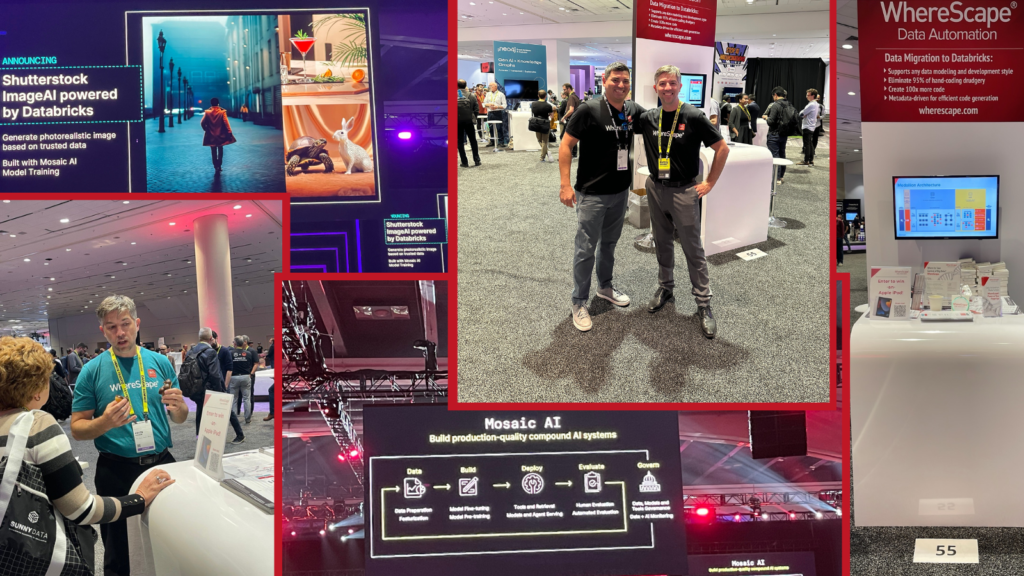
The Data + AI Summit 2024 has showcased rapid advancements and future directions in data management and AI. From the open-sourcing of Unity Catalog to the integration of generative AI, the innovations unveiled at the summit are poised to transform how organizations manage and leverage their data. As Databricks and its partners continue to push the envelope, the future of data management looks brighter than ever.
At WhereScape, we are inspired by these advancements and are committed to integrating these innovations into our solutions. The insights gained from the summit will guide us in empowering our clients to harness the full potential of their data, ensuring they stay ahead in an increasingly competitive market.
Ready to see how WhereScape can transform your data management strategy? Book a demo with WhereScape today and discover how our cutting-edge solutions can help you stay ahead in the data-driven world.